Hatsumomo loses control at a Pontocho party and is expelled from the okiya
Memoirs of a GeishaHatsumomo loses control at a Pontocho party and is expelled from the okiya after a public confrontation with Shojiro. The episode turns a carefully staged display of dancing and flirtation into a rupture: her attack shocks the gathering, earns her removal from the teahouse, and is followed by Mother’s decision to throw her out. Her departure exposes how thoroughly fear of her had shaped life in the okiya, while the account of what became of her afterward remains uncertain.
Setting and the party’s shifting attention
Around nine o’clock, the party crosses the river from Gion to Pontocho, a district arranged along a single alley beside the water. Shojiro’s gathering takes place outdoors on a wooden verandah raised above the river. Paper lanterns light the space, and the water reflects gold from a restaurant on the opposite bank. The scene begins as an animated social occasion: guests listen to Shojiro telling a story, and the narrator settles beside the blind koto player Tachibana Zensaku, whose company would have been enough for her even without the evening’s larger purpose.
The mood changes when Mameha performs. At the director’s urging, Shojiro reluctantly agrees to request a dance, although he would rather remain the center of attention. After Mameha performs several short pieces, he asks her to sit beside him, pours her sake, and turns his back on Hatsumomo. Mameha then flirts with deliberate theatricality, softening her voice and feigning a blush. The gathering’s attention has shifted, and Hatsumomo’s anger becomes increasingly visible.
The performance becomes a confrontation
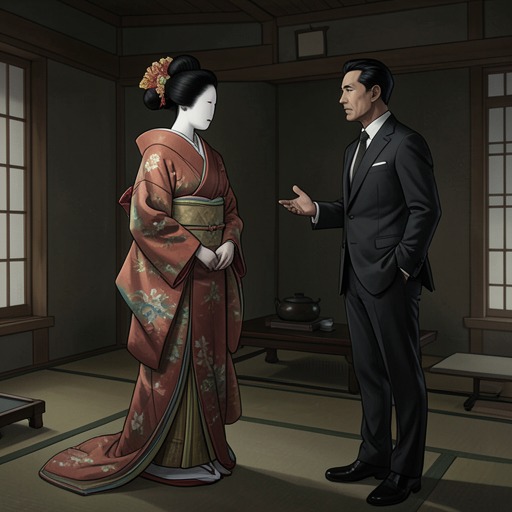
Shojiro makes the party laugh by contrasting his own dancing with the work of Bajiru. To demonstrate, he first sashays across the room with a folding fan, then takes Mameha in his arms, dips her toward the floor, and kisses her face. The guests cheer and clap; Hatsumomo does not. When she calls him a fool, Shojiro teases her for being jealous, and Mameha urges him to give Hatsumomo the same kisses he gave her.
The playful demonstration crosses into a genuine conflict. Shojiro manages to bring Hatsumomo to her feet and bends her back in an embrace, but she bites his lip. He jerks upright, grabs his mouth, and is struck by the force of the moment; Hatsumomo then slaps the side of his head. Her exposed teeth and narrowed, angry eyes replace the appearance of flirtatious jealousy with open hostility. The scene’s public comedy has turned into physical aggression before the guests, including Tachibana, who asks what has happened as the room falls quiet.
Mameha attempts to calm Hatsumomo, but the effort does not stop the escalation. Hatsumomo throws herself at Shojiro and begins hitting him. The narrator describes the moment as seeming to break away from everything around it: the theater director rushes to restrain her, while Mameha leaves briefly and returns with the teahouse mistress. Even after the director has taken hold of Hatsumomo, Shojiro shouts that she has bitten him. The mistress responds by soothing Shojiro while signaling the director to remove Hatsumomo.
Removal and expulsion
The director takes Hatsumomo downstairs and shoves her out onto the street. She does not return to the okiya that night. When she appears the following day, her hair is disordered and she smells as if she has been sick. Mother summons her to her room, where Hatsumomo remains for a long time. A few days later, she leaves the okiya carrying a bag of belongings and jewelry, dressed in a simple cotton robe Mother gave her. Her hair hangs loose around her shoulders, and she says goodbye to no one.
The departure is not voluntary: Mother has thrown her out. Mameha believes Mother may have wanted to be rid of Hatsumomo for years, though the narrator does not establish that as certain. The household’s immediate conditions also matter. Hatsumomo no longer earns what she once did, and food has become especially difficult to obtain; removing her means one fewer person to feed. The scene at the party is therefore followed not by a return to ordinary life but by a decisive change in Hatsumomo’s status and place in the household.
Aftermath and uncertain fate
Hatsumomo’s reputation closes off the possibility of an easy new beginning. The narrator compares her to a teakettle that could scald anyone who used it even on a good day, and notes that everyone in Gion understood her dangerousness. The comparison helps explain why another okiya might hesitate to take her in despite her past renown: her behavior has made her difficult to accommodate as well as feared.
The narrator cannot say for certain what becomes of Hatsumomo. A few years after the war, she hears a report that Hatsumomo is earning a living as a prostitute in Miyagawa-cho, but a man who goes looking for her cannot find her. The account ends with a further uncertainty: the narrator thinks Hatsumomo probably drank herself to death, while making clear that this is not confirmed. Her later life is thus presented through rumor and conjecture, not a witnessed ending.
What her departure changes
Only after Hatsumomo is gone do the people in the okiya begin to recognize how much strain her presence had imposed. The narrator likens their former accommodation to living with a bad leg: a persistent affliction can become part of ordinary life before its effects are fully understood. The maids had known that Hatsumomo was in the house and that she might abuse them during the day, a threat that made ordinary movement through the household feel precarious, like crossing a frozen pond whose ice could break.
Pumpkin, in particular, seems strangely lost without her older sister, suggesting that Hatsumomo’s harmful influence had also become a bond on which another person depended. The narrator herself has already become the okiya’s principal asset, yet continues to wonder whether a man’s strange look means he has heard some unkind thing Hatsumomo once said about her. The damage therefore outlasts the argument at the party and Hatsumomo’s physical departure: the household begins to heal, but the habits of fear and suspicion do not disappear at once.